

Hey there! As a supplier of mineral wool sandwich panels, I often get asked about the sound absorption coefficient of these panels. So, I thought I'd take a moment to break it down for you in a way that's easy to understand.
First off, let's talk about what the sound absorption coefficient actually is. In simple terms, it's a measure of how well a material can absorb sound. The coefficient ranges from 0 to 1, where 0 means the material reflects all the sound, and 1 means it absorbs all of it. For example, a hard, smooth surface like a glass window has a very low sound absorption coefficient—close to 0—because it reflects most of the sound waves that hit it. On the other hand, materials like thick carpets or acoustic foams have high coefficients, often close to 1, as they're great at soaking up sound.
Now, when it comes to mineral wool sandwich panels, they're pretty good at absorbing sound. Mineral wool is made from natural or synthetic minerals that are melted and spun into fibers. These fibers create a porous structure, which is key to sound absorption. When sound waves hit the panel, they enter these tiny pores. Inside the pores, the sound energy is converted into heat energy through friction between the air molecules and the fibers. This process reduces the intensity of the sound waves, effectively absorbing the sound.
The sound absorption coefficient of mineral wool sandwich panels can vary depending on a few factors. One of the main factors is the density of the mineral wool. Generally, higher - density mineral wool has a better sound absorption performance. A denser panel has more fibers per unit volume, which means there are more opportunities for the sound waves to interact with the fibers and get absorbed. However, it's not a linear relationship. There's an optimal density range for the best sound absorption, and going beyond that may not necessarily lead to a significant improvement.
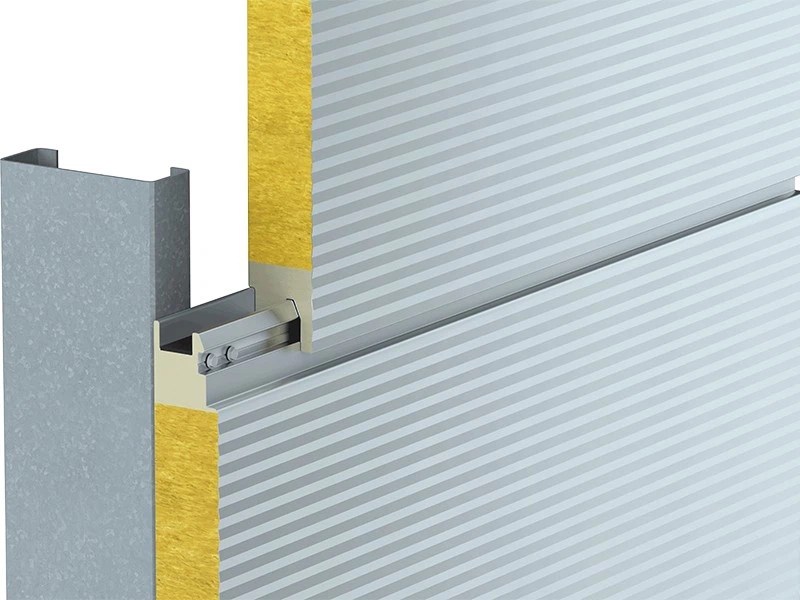

Another factor is the thickness of the panel. Thicker panels tend to have a higher sound absorption coefficient. As the sound waves travel through a thicker layer of mineral wool, they have more distance to interact with the fibers, increasing the chances of absorption. For example, a 100 - millimeter thick mineral wool sandwich panel will usually have a better sound - absorbing ability than a 50 - millimeter thick one.
The frequency of the sound also plays a role. Mineral wool sandwich panels are more effective at absorbing mid - to high - frequency sounds. Sounds in the range of 500 Hz to 2000 Hz are typically well - absorbed by these panels. This is important because a lot of the noise we encounter in daily life, like human voices, traffic noise, and some machinery sounds, fall within this frequency range.
Let me give you some real - world numbers. In general, a well - made mineral wool sandwich panel with a density of around 80 - 100 kg/m³ and a thickness of 80 - 100 mm can have a sound absorption coefficient of about 0.8 - 0.9 at mid - frequencies. That's pretty impressive! It means that the panel can absorb 80 - 90% of the sound energy in that frequency range.
So, where can you use these sound - absorbing mineral wool sandwich panels? They're great for a variety of applications. In commercial buildings, such as offices and conference rooms, they can help create a quiet and comfortable working environment. By reducing the noise from outside traffic or neighboring offices, employees can focus better on their work. In industrial settings, they can be used to line the walls of factories to reduce the noise generated by machinery. This not only makes the workplace more pleasant for the workers but also helps meet noise regulations.
If you're looking for other types of sandwich panels, we also offer Insulated Metal PIR PU Foam Sandwich Panel. These panels have excellent insulation properties in addition to some sound - absorbing capabilities. And for those who need fire - rated options, our Fire Rated Rock Wool Sandwich Panel Mineral Wool with PIR Side Sealing provides both fire protection and sound absorption. We also have Glass Wool Sandwich Panel for Wall, which is another option for sound - proofing and insulation.
If you're in the market for high - quality sandwich panels with good sound absorption properties, we're here to help. Whether you're a contractor working on a new building project, a facility manager looking to upgrade an existing space, or an architect designing a noise - sensitive environment, our mineral wool sandwich panels can be a great choice. We can customize the panels according to your specific requirements, including density, thickness, and size.
We understand that every project is unique, and we're committed to providing you with the best - suited products. So, if you're interested in learning more about our mineral wool sandwich panels or want to discuss your project in detail, don't hesitate to reach out. We're always happy to have a chat and help you find the perfect solution for your sound - absorption needs.
In conclusion, mineral wool sandwich panels are a reliable option for sound absorption. Their porous structure, combined with the right density and thickness, allows them to effectively reduce noise levels. Whether you're dealing with commercial, industrial, or other types of projects, these panels can make a significant difference in creating a quieter space.
References
- "Handbook of Acoustical Materials and Structures"
- "Building Acoustics: Noise Control and Sound Design"